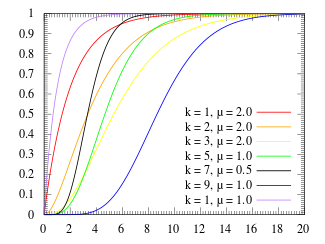
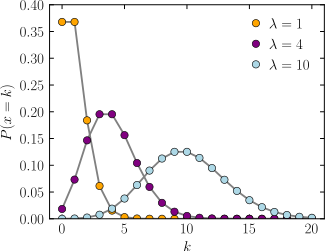
1) Random Variable X
2) Random Process (Stochastic Process) {X(t), t>=0} , 是一個Random Variable 的集合, (t可以是discrete time or continuous time)
3) Markov Process, 也是 Random Process,此Random Process {Xi,i=0,1,2....}是在描述狀態轉移的過程 (所有你會有一群狀態序列Chain), 但此系統的行為是chain中的節點,只和相鄰的節點有關,即你下一個狀態是什麼只取決你上一個狀態有關,而和先前的狀態無關 (此行為是是Markov property, 即Memory-less)
a discrete-time Markov Process--> Markov chain(DTMC)
a continuous-time Markov process--> Markov chain (CTMC)
4) Renewal process : is a counting process in which the inter-arrival times are an iid random sequence
在講時間,事件發生的間隔時間為一個隨機變數Ti , 若Ti 彼'此為iid 則此counting process為renewal process。 (只看時間,不看狀態)
5) Markov Renewal Process
將 Markov process 再加上時間, 則狀態轉換和時間產生了關係。 Markov Renewal Process 共包含了2個隨機變數 {Xi,Ti},狀態是一個隨機變數,時間也是一個隨機變數。也許我們想關心,在這個狀態待多久後會跳到下一個狀態。
6) Semi-Markov process
- If we define a new stochastic process
 for
for 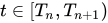 , then the process
  is called a semi-Markov process. Note the main difference between an MRP and a semi-Markov process is that the former is defined as a two-tuple of states and times, whereas the latter is the actual random process that evolves over time and any realisation of the process has a defined state for any given time. The entire process is not Markovian, i.e., memoryless, as happens in a continuous time Markov chain/process (CTMC). Instead the process is Markovian only at the specified jump instants. This is the rationale behind the name, Semi-Markov.[1][2][3] (See also: hidden semi-Markov model.)
Semi-Markov process 和Markov process的差異是,
會進入到某一個狀態 Xn ,只會發生在特定的時間區間,而不是發生在所有的時間點,因此,Semi-Markov Process 其Markovian 特性 (即memory-less的特性), 只會在特定時間而已 ,而非任意時間區間) 。即在Xn狀態只有和上一個狀態有關。而會落在上一個狀態其時間點也是特定的。
Ergodic
A random process is ergodic if its time average is the same as its average over the probability space,
在某一段時間的平均, X/Ti 和 整個時間的平均 X /T 是相同, 則稱為ergodic
Markov Model ( 所有狀能已知)
馬可夫模型是一連串事件(狀態)接續發生的機率
馬可夫鏈(英語:Markov chain),又稱離散時間馬可夫鏈(discrete-time Markov chain,縮寫為DTMC[1]),因俄國數學家安德烈·馬可夫(俄語:Андрей Андреевич Марков)得名,為狀態空間中經過從一個狀態到另一個狀態的轉換的隨機過程。
A Markov chain is a
stochastic process with the
Markov property. The term "Markov chain" refers to the sequence of random variables such a process moves through, with the Markov property"
memorylessness"). defining
serial dependence only between adjacent periods (as in a "chain").
It can thus be used for describing systems that follow a chain of linked events, where what happens next depends only on the current state of the system.
已定義所有的狀態, 並有定義好從狀態 i 到各個狀態 j 的機率, 若共有N個狀態, 這就有一個矩陣描述每一個狀態彼此間的轉移的機率, ,這就狀態轉移機率矩陣 (State Transition probability matrix)
存在在一個狀態序列
常問的問題:
- 我們也許想知道, 原本在S0 狀態,經過T步後, 會落在那一個狀態? ( 這會需要知道 Pij : 狀態i 到 j 的機率)
- S0-->S1-->S2, 一開始在S0走2步後, 出現在S2的機率為何?
Relation to other stochastic processes[edit]
- A semi-Markov process (defined in the above bullet point) where all the holding times are exponentially distributed is called a CTMC. In other words, if the inter-arrival times are exponentially distributed and if the waiting time in a state and the next state reached are independent, we have a CTMC.


- The sequence
 in the MRP is a discrete-time Markov chain. In other words, if the time variables are ignored in the MRP equation, we end up with a DTMC.

- If the sequence of
 s are independent and identically distributed, and if their distribution does not depend on the state , then the process is a renewal process. So, if the states are ignored and we have a chain of iid times, then we have a renewal process.

- 事件發生的時間和狀態都無關(不論狀態是過去,現在或未來的狀態)
Hidden Markov Model (存在未知狀態)
也許某些情況,我們無法或根本無法完整定義所有事件(狀態)的轉移機率矩陣 ,
 |
| 圖來源: http://www.csie.ntnu.edu.tw/~u91029/HiddenMarkovModel.html#1 |
存在一個Hidden State ,不知道內部會怎麼選的機制, 而僅知道 S1,S2,S3狀態
在這個例子裡,有兩個事件的序列:一個是我觀察得到的;另一個是我看不到的,也就是對我來說是隱藏的,就是Hidden State。由於我知悉這兩個馬可夫鏈之間的關係,所以我便可以由其中一個馬可夫鏈的狀態,去預測另一個馬可夫鏈的狀態。而「隱馬可夫模型」,便是描述這樣的兩個序列的關係的統計模型。
HMM讓我們可以利用「看得到的」連 續現象去探究、預測另一個「看不到的」連續現象。
隱藏馬可夫模型的特色就是:我們只看到了觀察序列(果),但是我們看不到狀態序列(因);我們只看到了依序噴出的 T 個值,但是我們看不到一路走過的是哪 T 個狀態。
References:


![{\displaystyle {\boldsymbol {\mu }}=\left[{\begin{smallmatrix}0\\0\end{smallmatrix}}\right]}](https://wikimedia.org/api/rest_v1/media/math/render/svg/288f20c89fee827ad086cec03369439ba3615d7f)
![{\displaystyle {\boldsymbol {\Sigma }}=\left[{\begin{smallmatrix}1&3/5\\3/5&2\end{smallmatrix}}\right]}](https://wikimedia.org/api/rest_v1/media/math/render/svg/ee3a76f734b37fcce91f30617152fe104b2782bc)